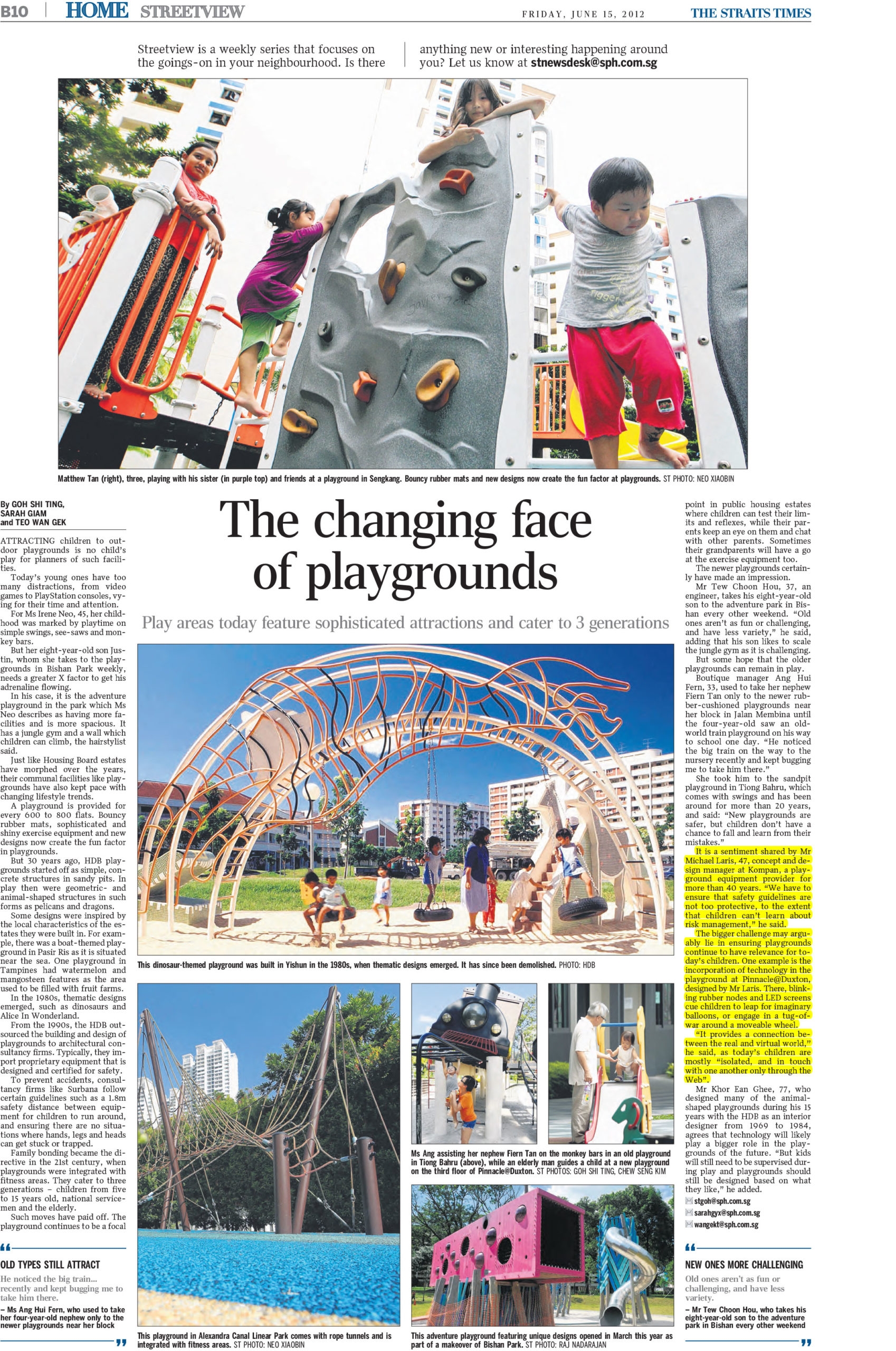
Attracting children to outdoor playgrounds is no child’s play for planners of such facilities.
Today’s young ones have too many distractions, from video games to PlayStation consoles, vying for their time and attention. For Ms Irene Neo, 45, her childhood was marked by playtime on simple swings, see-saws and monkey bars.
But her eight-year-old son Justin, whom she takes to the playgrounds in Bishan Park weekly, needs a greater X factor to get his adrenaline flowing.
In his case, it is the adventure playground in the park which Ms Neo describes as having more facilities and is more spacious. It has a jungle gym and a wall which children can climb, the hairstylist said.
Just like Housing Board estates have morphed over the years, their communal facilities like playgrounds have also kept pace with changing lifestyle trends.
A playground is provided for every 600 to 800 flats. Bouncy rubber mats, sophisticated and shiny exercise equipment and new designs now create the fun factor in playgrounds.
But 30 years ago, HDB playgrounds started off as simple, concrete structures in sandy pits. In play then were geometric- and animal-shaped structures in such forms as pelicans and dragons.
Some designs were inspired by the local characteristics of the estates they were built in. For example, there was a boat-themed playground in Pasir Ris as it is situated near the sea. One playground in Tampines had watermelon and mangosteen features as the area used to be filled with fruit farms.
In the 1980s, thematic designs emerged, such as dinosaurs and Alice In Wonderland.
From the 1990s, the HDB outsourced the building and design of playgrounds to architectural consultancy firms. Typically, they import proprietary equipment that is designed and certified for safety.
To prevent accidents, consultancy firms like Surbana follow certain guidelines such as a 1.8m safety distance between equipment for children to run around, and ensuring there are no situations where hands, legs and heads can get stuck or trapped.
Family bonding became the directive in the 21st century, when playgrounds were integrated with fitness areas. They cater to three generations – children from five to 15 years old, national servicemen and the elderly.
Such moves have paid off. The playground continues to be a focal point in public housing estates where children can test their limits and reflexes, while their parents keep an eye on them and chat with other parents. Sometimes their grandparents will have a go at the exercise equipment too.
The newer playgrounds certainly have made an impression.
Mr Tew Choon Hou, 37, an engineer, takes his eight-year-old son to the adventure park in Bishan every other weekend. “Old ones aren’t as fun or challenging, and have less variety,” he said, adding that his son likes to scale the jungle gym as it is challenging.
But some hope that the older playgrounds can remain in play.
Boutique manager Ang Hui Fern, 33, used to take her nephew Fiern Tan only to the newer rubber-cushioned playgrounds near her block in Jalan Membina until the four-year-old saw an oldworld train playground on his way to school one day. “He noticed the big train on the way to the nursery recently and kept bugging me to take him there.”
She took him to the sandpit playground in Tiong Bahru, which comes with swings and has been around for more than 20 years, and said: “New playgrounds are safer, but children don’t have a chance to fall and learn from their mistakes.”
It is a sentiment shared by Mr Michael Laris, 47, concept and design manager at Kompan, a playground equipment provider for more than 40 years. “We have to ensure that safety guidelines are not too protective, to the extent that children can’t learn about risk management,” he said.
The bigger challenge may arguably lie in ensuring playgrounds continue to have relevance for today’s children. One example is the incorporation of technology in the playground at Pinnacle@Duxton, designed by Mr Laris. There, blinking rubber nodes and LED screens cue children to leap for imaginary balloons, or engage in a tug-ofwar around a moveable wheel.
“It provides a connection between the real and virtual world,” he said, as today’s children are mostly “isolated, and in touch with one another only through the Web”.
Mr Khor Ean Ghee, 77, who designed many of the animalshaped playgrounds during his 15 years with the HDB as an interior designer from 1969 to 1984, agrees that technology will likely play a bigger role in the playgrounds of the future. “But kids will still need to be supervised during play and playgrounds should still be designed based on what they like,” he added.
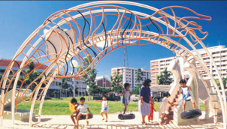
This dinosaur-themed playground was built in Yishun in the 1980s, when thematic designs emerged. It has since been demolished.
PHOTO: HDB
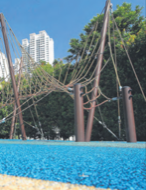
This playground in Alexandra Canal Linear Park comes with rope tunnels and is integrated with fitness areas.
ST PHOTO: NEO XIAOBIN
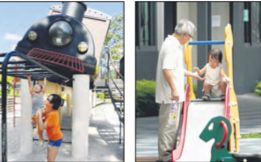
Ms Ang assisting her nephew Fiern Tan on the monkey bars in an old playground in Tiong Bahru (above), while an elderly man guides a child at a new playground on the third floor of Pinnacle@Duxton.
ST PHOTOS: GOH SHI TING, CHEW SENG KIM
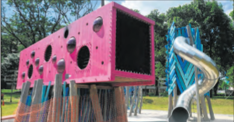
This adventure playground featuring unique designs opened in March this year as part of a makeover of Bishan Park.
ST PHOTO: RAJ NADARAJAN