Companies here can exploit Quality and Standards (QS) certification to gain a competitive edge in business through lower costs and higher productivity. Spring Singapore has help schemes for this, and Melissa De Silva reports on some companies which have benefited from the adoption of QS.
Enterprises need to deal with an increasingly demanding business landscape in which high-quality products and services are demanded at competitive prices.
A key strategy to meet this demand is via the adoption of Quality and Standards (QS) certification, which allows companies to benchmark themselves and assure consumers and other businesses of their quality.
Over the years, Spring Singapore has built up a strong QS infrastructure to facilitate this. This infrastructure consists of an ecosystem of companies, standards and accreditation partners, conformity assessment bodies, regulators, researchers and academia.
The ecosystem allows businesses to meet basic safety, quality, health, environmental and design standards.
Says Ms Choy Sauw Kook, Spring’s assistant chief executive (quality and excellence): “It has been instrumental in attracting and anchoring MNCs (multinational corporations) to Singapore due to the good testing, inspection and certification facilities available to support their operations here.
“The adoption of QS has also allowed companies to achieve greater market access abroad, by meeting stringent global quality requirements.”
For example, the BCA Green Mark is well accepted regionally and construction firms certified it will be in a better position when bidding for projects.
Besides this, there are several other benefits of adopting QS, explains Ms Choy.
Companies can use it to strengthen their capabilities, raise productivity, cut costs and enhance competitiveness. This is because QS adoption can streamline processes, minimise disruptions and cut wastage.
QS can also help businesses attract and retain consumers, who are now more discerning and will compare products to see what specifications are met.
Says Ms Choy: “Purchasing decisions are not only based on cost, but also on safety, quality, effect on health, environmental friendliness and fair trade.
“Some buyers look for a certification mark or certification report. Some will do business only with suppliers certified to particular standards.
“Consumers are also increasingly aware of standards. Some will not buy furniture unless it is certified with Greenguard not to contain environmentally harmful chemicals.
“Others look for the HACCP mark and ISO 22000 certification on food to ensure that it is made under hygienic conditions.”
Turning to the branding of Singapore products and services in the international marketplace, she says that they are seen as being reliable and of good quality. “This is partly the result of a robust QS infrastructure, where there are relevant standards for businesses and a pool of accredited service providers to ensure the quality of products and services.”
She adds: “Moving forward, the QS infrastructure will need to cater to emerging needs and technological trends as well as continue to strengthen and safeguard the Singapore brand.”
In line with this, Spring’s help schemes have been expanded to include new standards such as for business continuity management and information security.
Meanwhile a code of practice for the efficient use of centrally chilled water and a Singapore standard for efficient water use were developed last year to help businesses minimise their environmental footprint and cut operating costs.
These moves align with the fact that more companies are concerned with information security, risk management and resilience.
They are also aligned with growing global concerns about resource efficiency and waste management.
Towards workforce that’s standards-ready
Standards partners are critical to the success of the Singapore Standardisation Programme. They are volunteers from both the public and private sectors, and they provide leadership and technical expertise to develop and promote important standards that benefit the industry, government agencies and the public. According to Mr Edwin Khew, chairman of Singapore Standards Council (SSC), they ensure that the local and international standards developed or reviewed are robust and consensus-based and reflect the latest thought-leadership or technological development. Mr Khew says: “The tireless work of our standards partners has enabled us to develop and review nearly 500 standards since 2011 as well as support national priorities such as facilitating new growth areas, raising productivity, promoting resource efficiency and ensuring social and safety needs are met.” Explaining how the SSC’s work helps businesses, he says that in today’s global market, business growth and survival depend on the speed of communication and development of cutting-edge technologies and their adoption. “Standards underpin these technologies which impact how business is being done now and in the future. “For everything we use today – from the simple lithium battery and mobile phone to the Airbus A-380 – standards are key to their production. “As a business, if you do not adopt standards, you will lose your competitiveness and, eventually, market relevance.” New standards need to be developed to support the introduction of new technologies, products and services, he notes. For example, the council is working with stakeholders to develop new standards to support wearable dialysis equipment developed by a Singapore start-up. He says: “We are working to develop these standards in a timely manner so that their progress to market on a global basis is not impeded.” To ensure sustainability and growth in the use of standards among new entrants into the workforce, the council is looking at working with tertiary institutions to introduce standards as electives, and even promoting standards awareness in secondary schools and junior colleges. Says Mr Khew: “This will help our pre-workforce to gain a good foundation in using standards as a strategic business tool. “We hope to develop standards-literate and standards-ready employees of the future.”
Creating confidence in accreditation processes
The Singapore Accreditation Council (SAC) comprises representatives from the private and public sectors, professional and conformity assessment bodies, industries and user groups. It is responsible for decisions on accreditation matters, and establishes accreditation schemes and formulates policies. It reviews and improves the accreditation framework and this ensures that its programmes are in line with global business demands and trends. “The council members’ diverse backgrounds and experiences contribute to the rigorous review of its various programmes on an ongoing basis as well as provide direction and guidance for the future,” says Mr Renny Yeo, the council’s chairman. He adds: “On the international front, the SAC participates in international meetings, which adds value to industry as we exchange best practices, harmonise accreditation work and establish mutual recognition arrangements to facilitate the acceptance of goods and services across borders. “These efforts have led to SAC’s strong international branding, which is recognised around the world. “With this, the industry can be assured that the SAC brand can be trusted and its accreditation programmes are kept relevant and in line with industry needs,” he says. “Ultimately, the SAC hopes to provide confidence to end users, that accreditation is done according to international standards.
No accreditation means no business
For Cast Laboratories, standards and accreditation are the basis of its entire business. The company, which began as a small concrete-testing facility in 1981, now tests materials used in the construction, shipyard, oil and gas industries, here and abroad. Its adoption of standards, starting in 1988 with Civil Engineering Testing certification, was prompted by the Government’s move to get such laboratories’ test certificates recognised, says Mr William Tay, its executive chairman. Customers insist that testing, calibration and inspection services are done only by Singapore Accreditation Council (SAC) accredited labs. Without accreditation there would hardly be any business. For CAST Laboratories, accreditation meant customers could trust that its on-site concrete and steel test reports were accurate and reliable, and it led to a larger and wider client base. Cost can be a big barrier to adopting a standard and gaining accreditation, says Mr Tay. He says: “For all standards, when a new version comes out – every three to five years – we have to upgrade by getting new equipment.” He notes that to upgrade to the Advanced ISO/IEC 17025 Non-Destructive Testing equipment, for example, would cost up to about $500,000. He notes that the company is now facing one consequence of strict accreditation criteria. He explains that accreditation is specific to a laboratory’s location and if it were to move its machines to other premises it voids the accreditation. Hence, CAST Laboratories will have to go through the process of re-gaining accreditation when it vacates its Defu industrial estate premises some years from now. This is because the estate is slated for redevelopment and the industries there will have to move out by 2019. However, Mr Tay says, CAST Laboratories will still go for accreditation. “We are 30 years in the business and making money; so getting accreditation must be worthwhile.” He adds: “Spring helps with support, too. For example, it helped cover the costs of flying in a trainer from New Zealand to train staff in an upgraded standard in June this year.”
Don’t play-play with safety
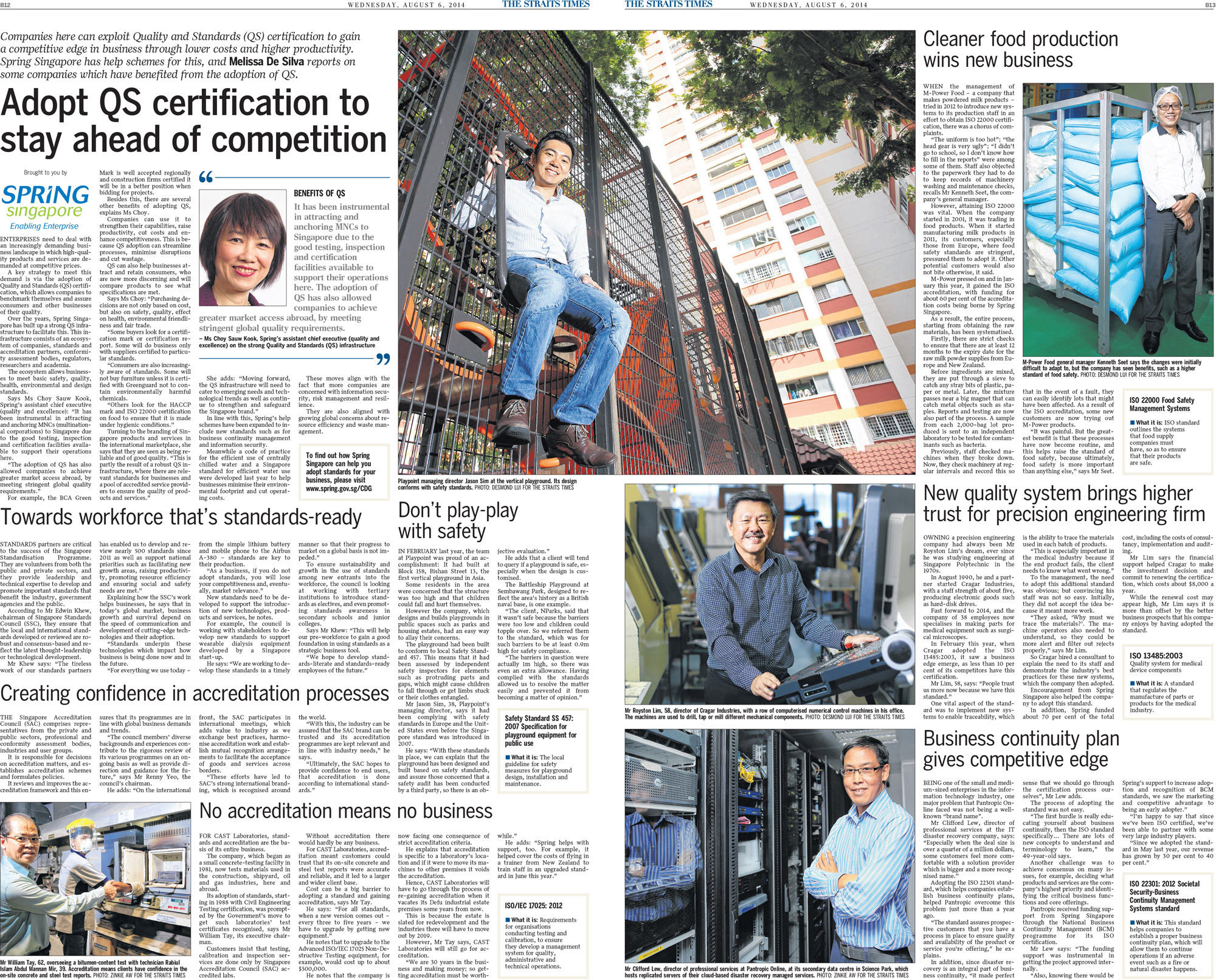
In February last year, the team at Playpoint was proud of an accomplishment: It had built at Block 158, Bishan Street 13, the first vertical playground in Asia. Some residents in the area were concerned that the structure was too high and that children could fall and hurt themselves. However the company, which designs and builds playgrounds in public spaces such as parks and housing estates, had an easy way to allay their concerns. The playground had been built to conform to local Safety Standard 457. This means that it had been assessed by independent safety inspectors for elements such as protruding parts and gaps, which might cause children to fall through or get limbs stuck or their clothes entangled. Mr Jason Sim, 38, Playpoint’s managing director, says it had been complying with safety standards in Europe and the United States even before the Singapore standard was introduced in 2007. He says: “With these standards in place, we can explain that the playground has been designed and built based on safety standards, and assure those concerned that a safety audit has been conducted by a third party, so there is an objective evaluation.” He adds that a client will tend to query if a playground is safe, especially when the design is customised. The Battleship Playground at Sembawang Park, designed to reflect the area’s history as a British naval base, is one example. “The client, NParks, said that it wasn’t safe because the barriers were too low and children could topple over. So we referred them to the standard, which was for such barriers to be at least 0.9m high for safety compliance. “The barriers in question were actually 1m high, so there was even an extra allowance. Having complied with the standards allowed us to resolve the matter easily and prevented it from becoming a matter of opinion.”